Industrial Policy for Housing Construction




After years of struggle, the push to roll back the land-use constraints that have long suppressed America's housing supply appears to be gaining momentum. States big and small, red and blue, have passed significant land-use reforms. The movement has spread beyond major metropolitan areas to less urbanized ones, with particular progress being made on legalizing accessory dwelling units and the subdivision of single-family lots.
As critical as it is, liberalizing land use is only one piece of the housing-supply puzzle. The less obvious part, especially outside the highest-priced markets, is the cost and speed of building itself.
Since the 1970s, productivity in the nation's housing sector has steadily declined. This is no doubt in part due to the complicated political economy of land use in the United States, which fractures the housing market geographically and produces a thorny combination of limited competition and insufficient scale. But a significant part of the problem is the absence of innovative, viable business models that can reduce the cost and time required to construct housing.
Breakthroughs in legalizing land use, therefore, will only go halfway toward making housing more affordable. Building the housing we need will require addressing both legal and business impediments.
The way forward requires combining continued liberalizing of land-use rules with a relatively light-touch industrial policy for factory-built housing — homes or housing components manufactured in controlled factory environments, as opposed to entirely on site. This method offers the only realistic path to achieving the dramatic productivity gains necessary to make housing affordable. While disruptive, a well-designed industrial policy can help unlock productivity benefits in housing that spill over to our nation's broader economic well-being.
THE ECONOMICS OF HOUSING CONSTRUCTION
Throughout the 20th century, nearly every category of tradeable goods — from motor vehicles to airplanes to consumer appliances — underwent a revolution in productivity growth. All of this was thanks to factory-based assembly-line methods developed by Henry Ford.
Factories drove these massive productivity gains through several mechanisms. First, they enabled specialization, allowing workers to focus on mastering a few key tasks rather than managing the entire production chain. Factories also created regulated environments, which improved quality control while helping to prevent variable delivery schedules and bad weather from disrupting production. Third, factories allowed for capital intensity, which replaced human labor with specialized machinery and continuous process improvement over time. Finally, factories helped simplify the production process and reduce the number of required inputs.
Consequently, factories achieved economies of scale in purchasing materials, training workers, and spreading fixed costs over units. All of this drove down per-unit costs while increasing the quality, consistency, and speed of production.
Housing was and remains a notable exception to the pattern. As academics such as Austan Goolsbee and Chad Syverson have documented, homes built per construction worker have stagnated, and even declined, for decades. While land-use barriers have played some role (as emphasized in work by Edward Glaeser, Joseph Gyourko, and co-authors), the pattern is national, and the productivity slowdown associates only weakly with existing measures of housing regulatory strictness. The decline appears to be related to the failure of the housing sector to embrace the factory-based mass-production techniques that have been the basis for productivity growth in other sectors for over a century.
So why has housing failed to make the switch? Five key barriers help explain that failure.
The first is housing's exceptionally high degree of durability. Unlike simple appliances or even goods like automobiles, residential structures have a long lifespan. This factor has important implications for consumer demand. When recessions hit, consumers significantly reduce their consumption of durable goods, even as they continue purchasing non-durable services and less-durable goods. As a result, housing construction faces a boom-bust cycle with respect to production, as Brian Potter and Chad Syverson have shown, which represents a grave threat to the viability of industrial models of housing production over the long term.
A second challenge is the historic lack of government support for the housing-construction sector. Despite issues with high durability, other goods with long lifespans, such as airplanes and ships, saw increases to their production throughout the 20th century thanks to government intervention and purchases. These industrial policies helped to smooth out swings in demand and provide a measure of guaranteed growth, which facilitated productivity-enhancing investments. Housing never received comparable attention, largely because it lacks the usual justifications for such intervention: It is not an export industry, faces little foreign competition that would justify import substitution, and has no obvious national-security rationale. As a result, the construction sector has been left to absorb the full force of business cycles on its own.
The third problem is the patchwork nature of housing regulations throughout the United States. Fragmented zoning and building codes limit the quantity of houses that can be produced under any one regime. Instead, firms need to do careful research to cater to complex and varying standards, as well as adapt to and invest in the politics of particular jurisdictions. This requires higher customization and limits the scale of the addressable market.
A fourth problem is the challenge of transporting houses built in factories to construction sites. Manufactured housing comprises two main segments: prefabrication, where specific components are manufactured off site, and modular construction, where entire room-sized sections are built in factories and transported to sites for assembly. Due to the challenge of transporting bulk goods, housing manufacturers typically have a much smaller economically viable delivery radius than those that produce other goods. This limits the potential size of markets and further increases companies' vulnerability to even local economic downturns.
Finally, there is the hurdle of land aggregation and parcel assembly. Mid-century developers like the Irvine Company were able to create entire new planned cities like Irvine, California, which enabled economies of scale in production. But parcel availability near urban centers is scarcer today, which means developers face a challenge in assembling enough adjacent parcels to build. Land fragmentation means that individual developers find it challenging to develop economies of scale themselves in the construction process, particularly for in-fill development.
The housing-construction sector has adopted several strategies to cope with these structural challenges. The risks inherent in business-cycle fluctuations and regulatory complexity have lent themselves to a fragmented industry dominated by many small firms with limited capital. These firms prioritize flexibility and risk management, as opposed to efficiency and scale. They typically do not handle all of the construction work on site themselves, instead relying on a network of subcontractors that allow them to ramp production up and down with business cycles while avoiding the fixed costs of large permanent workforces or intensive capital.
This approach has been reinforced by the industry's reliance on relatively low-cost labor, particularly through immigration patterns that have historically provided a steady stream of workers willing to take on physically demanding and intermittent work at relatively low wages. A report by the Center for American Progress, "Undocumented Immigrants in Construction," highlights that a fifth of undocumented workers are employed in a construction-related sector, and more than one in 10 construction workers are undocumented.
This labor force has helped keep construction costs relatively manageable despite stagnant productivity growth. It has also ensured reserve labor capacity, allowing the industry to ramp up and down as necessary. But workforce availability, along with geographically limited scale of firms, may also have reduced the economic pressures to invest in capital-intensive and productivity-enhancing technology.
Builders have adapted to these challenges by specializing in assembling temporary teams of subcontractors, coordinating on-site assembly processes, and navigating local regulatory environments. This has come at the cost of standardization, vertical integration, mechanization, and the economies of scale that have improved productivity in other sectors, and has left the construction industry vulnerable to shocks in immigration enforcement.
THE RISE AND FALL OF FACTORY-BUILT HOUSING
These forces explain why the story of factory-built housing in America is one of remarkable booms followed by devastating busts, from the last of which the industry has never recovered. This history has important lessons for any future attempts to change the entrenched patterns of American housing construction.
The early 1900s saw an unusual explosion of factory-built housing in the form of mail-order catalogs. While Sears Modern Homes is the most commonly remembered version, it was not even the largest player in the market at the time, which saw mass housing construction using components delivered by rail or truck to individuals to self-assemble (or contract out). This overlapped with the explosion of mass production that brought about Henry Ford's Model-T. Bay City, Michigan, for example, hosted a significant cluster of prefabricated-housing firms, drawing in part on the city's proximity to fast-growing cities in the upper Midwest and abundant timber in the north of the state.
This wave came to an end with the Great Depression. Auto sales also experienced a massive slump during this period, as did manufacturing in general. But Sears and other companies were doubly hit because they not only sold homes; they offered financing as well, and saw significant numbers of existing homeowners default. So while car manufactures struggled but survived, and eventually got a lifeline in the form of World War II contracts to build tanks and other equipment, the depression ultimately put factory-home builders out of business.
Despite the setback, housing production enjoyed another boom after World War II. Highways opened up suburban sprawl, and developers built communities like Levittown — large tracts constructed through assembly-line-like methods. Other housing was built in factories and simply assembled on site. These methods remained a large component of housing production through the 1970s.
The stagflation of that period, however, crushed the manufactured-housing sector. The economy went through periodic booms and busts, seeing large swings in interest rates and demand. Housing production in particular was unusually volatile, reflecting the fact that housing rents remained robust but financing and supply conditions varied, ultimately bankrupting the last few firms in the industry. State and local crackdowns on multi-family housing — through zoning barriers on deployment, as well as real-property titling restrictions that limit mortgage access — further reduced the market's viable scope.
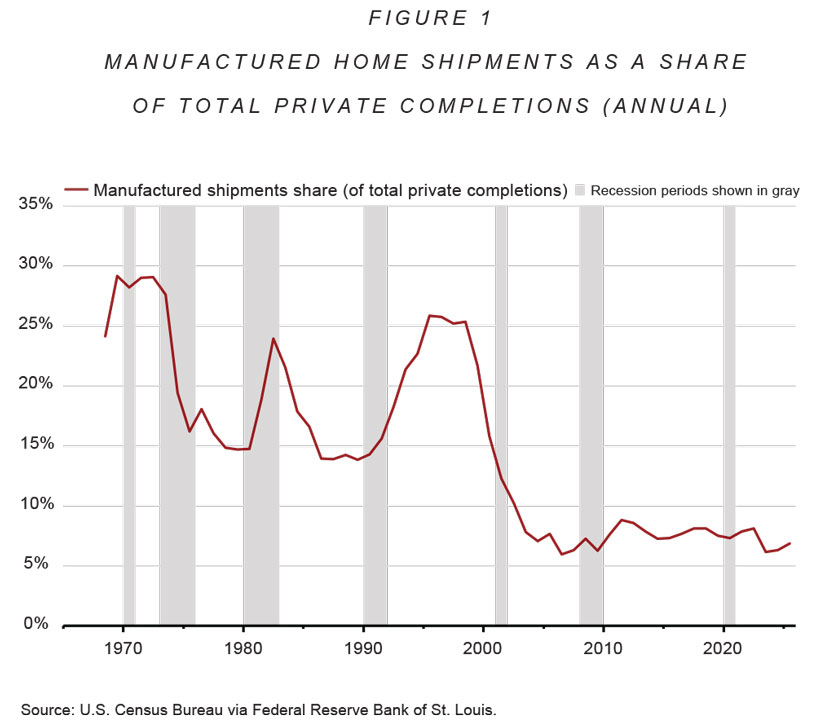
The industry suffered its last major death knell in the early 2000s. The Great Recession of 2008 was unusually severe for the lower end of the housing segment, where manufactured housing provided the most units. Figure 1 below highlights the decline in shipments of manufactured homes that met federal standards, but the broader picture for modular and panelized construction was similar, showing substantial drop offs after 2008.
OPERATION BREAKTHROUGH
Amid this generally declining backdrop, one episode of government intervention is particularly notable: Operation Breakthrough. This major Housing and Urban Development (HUD) initiative from 1969 through 1974 was launched to advance the development of industrialized methods of construction.
Under Secretary George Romney, HUD funded 22 companies to develop innovative new housing systems. As part of this effort, the department created a performance-based federal building code, moving away from traditional prescriptive codes to allow for more innovative construction methods.
HUD also worked with local governments to streamline zoning regulations that had previously hindered innovative housing development and negotiated with trucking regulators to ease transportation restrictions for modular-housing components. Additionally, the department engaged with labor unions to facilitate factory-based assembly processes that differed from traditional on-site construction methods. These efforts ultimately led to the HUD Code for factory-built homes — a series of national standards for manufactured-housing products. While elements of this code have since come under criticism, at the time, the code increased manufactured homes' safety and acceptability.
To create market demand for these innovative segments, HUD also made significant purchasing commitments. The agency earmarked 25,000 units of federally subsidized housing to be constructed using modular building systems. This guaranteed market was designed to provide critical support for the new technologies during their developmental-scale phase, giving companies the confidence to invest in systems while they matured.
Operation Breakthrough ultimately succeeded as a pilot program. It demonstrated convincingly that innovation in housing production could work in practice. It showed that alternative building methods could deliver housing at scale when properly supported. And it represented a success in shifting the regulatory agenda.
But the initiative ultimately failed to facilitate new firms and production techniques that could compete successfully in the open market after government support ended. The fundamental problems were those of timing and consistency. The emerging production methods supported by Operation Breakthrough lacked the sustained timelines and reliable demand necessary to achieve economies of scale. An additional problem was geographic segmentation: By supporting pilot programs across nine sites, the initiative was subject to the fragmentation of the broader housing landscape. Without the support of a substantial commitment from the government, the new methods of housing construction were not able to compete with traditional construction methods on price and efficiency.
Operation Breakthrough offers an important lesson about government intervention in emerging industries: It shows that public backing for research and standardization can indeed result in substantial benefits. But fully taking advantage of these benefits requires sustained fiscal commitment over the long term, providing companies with the stability necessary to scale up new technologies and establish themselves as viable market competitors.
Housing also presents a distinct challenge compared to other targets of industrial policy. Because construction is an inherently domestic industry, emerging firms cannot look to export markets as an additional source of demand while they scale. This means that policy must be focused on intentionally agglomerating and stabilizing local demand. At the same time, the domestic nature of housing construction means that the goal should not be to create "national champions" capable of competing with (possibly subsidized) foreign rivals. Rather, the aim should be to foster a competitive domestic industry composed of larger, nationally integrated firms that can stand on their own and achieve economies of scale currently challenging to meet in a fragmented market.
INDUSTRIAL HOUSING ABROAD
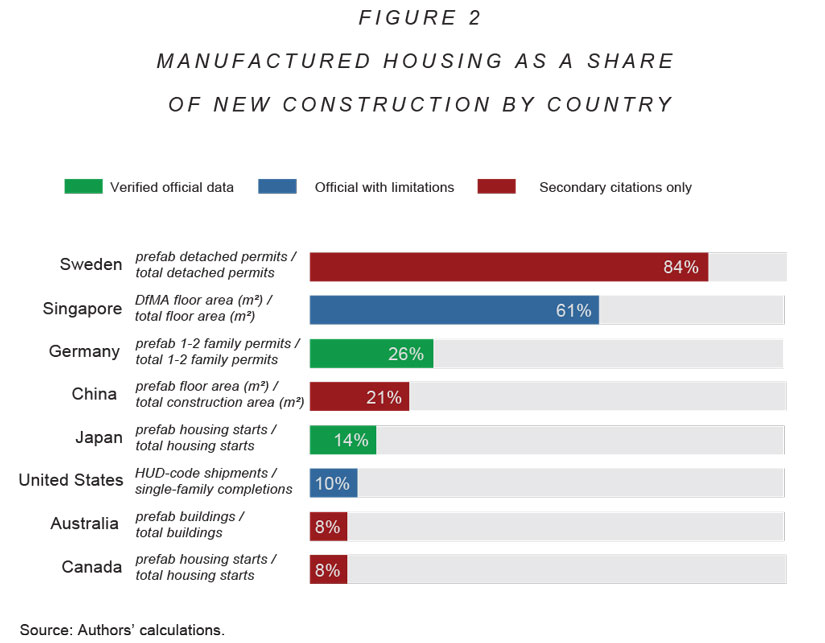
While HUD's Operation Breakthrough was only a very limited success, other countries have seen much greater returns from their industrial-policy efforts for housing (see Figure 2 below).
Sweden, for instance, launched an ambitious factory-construction initiative to build one million dwellings during the 1960s. The program's success stemmed from two key factors: the implementation of uniform, performance-based building codes that enabled standardization across projects, and the development of a new ecosystem encompassing specialized firms and financing mechanisms.
The country's two major housing cooperatives played a critical role in aggregating demand for factory-built construction. The program proved remarkably effective, with 84% of detached homes constructed in Sweden now using prefabricated elements. While it's difficult to find a comparable statistic for the United States, such construction processes face a considerably higher barrier to being approved across America's diverse jurisdictions.
Today, Sweden's factory-oriented housing-production process offers significant benefits in the speed of construction. For developers, time is as valuable as money, because a faster and more certain development process raises the rate of return, enabling higher profits and more projects to pencil out under standard "hurdle rates" of required investment return. Notably, Sweden also has high performance specifications on dimensions like energy efficiency, ventilation, and airtightness, which offset some of the savings from factory-built construction. Despite these higher requirements, the typical cost of building multi-family units in Sweden lies below that of the most expensive coastal markets in the United States.
Japan followed a similar approach, with results mirroring its industrial-policy success in other domains. In 1963, the Japan Prefabrication Construction Suppliers and Manufacturers Association, which set rigorous quality standards and actively promoted factory-built housing, was founded. Japan even highlighted a prefabricated home at the 1970 World Expo. As in the automobile sector, Japan's construction sector has maintained integrated supply chains and continuous research-and-development units, enabling the production of more than 10 million prefabricated housing units.
Even in America, certain state-based initiatives have proven successful. Colorado's Proposition 123 established the Innovative Housing Incentive Program (IHIP), which provides performance-based grants to housing manufacturers with payouts directly tied to the delivery of affordable housing units. The state complemented this initiative with a modular-factory loan program that offers low-interest financing for factory-expansion projects.
California's adoption of common performance standards for accessory-dwelling-unit (ADU) production has significantly increased the state's ADU supply. Standardizing requirements statewide has enabled companies to produce ADUs efficiently in factory settings, significantly expanding the market. The reform has attracted numerous new manufactured-housing companies to the state, many of which focus on manufactured construction of ADUs placed on site.
At the federal level, too, there are signs of growing bipartisan recognition that factory-built housing needs policy support. The ROAD to Housing Act of 2025, developed with significant input from the Niskanen Center and advanced unanimously out of the Senate Banking, Housing, and Urban Affairs Committee with co-sponsorship from senators Tim Scott and Elizabeth Warren, directly targets several longstanding federal barriers to manufactured housing. These are important steps. However, creating a competitive manufactured-housing industry may require an even more ambitious strategy to tackle the fundamental market and regulatory frictions that have so far inhibited the sector's growth.
LIGHT-TOUCH INDUSTRIAL POLICY
The transition to a robust factory-built housing sector requires coordinated government intervention across multiple domains. This calls for industrial policy — strategic government support for industries and technologies through targeted interventions that include research funding, procurement guarantees, tax incentives, and regulatory guidance. Industrial policy in an inherently domestic industry like housing, however, looks more like "national deregulatory liberalism" than "anti-competitive protectionist dirigisme."
Light touch, liberal industrial policy is appropriate in the context of housing construction, which is subject to substantial coordination failures that render firms unable to offset costs or make a profit on their own. Drawing lessons from successful industrial policies in other sectors and international experiences with manufactured housing, we propose five key areas of policy intervention that address the fundamental market failures preventing a competitive manufactured-housing industry from emerging. The first four, which focus on making the industry financially viable, are launching a factory-built technology research-and-development program, pursuing procurement reform and demand aggregation, establishing financial incentives and risk-mitigation efforts, and developing manufactured-home loan-guarantee programs. The final step — advancing comprehensive regulatory and legal reform — will be discussed in the following section.
The first step will be to fund the underlying research and technologies that will facilitate a broader shift in construction practices. To accomplish this, the government should establish a comprehensive research-and-development program to advance factory-built technology and create the evidence base necessary to convince both policymakers and private investors of its viability.
This effort could focus on creating an Advanced Research Projects Agency-style program for housing innovation, building on existing initiatives like the Department of Energy's Advanced Building Construction Initiative. The program should operate at a sufficient scale to meaningfully reduce the risks of private investment. This will require committing to funding the program over the following decade at a rate of $500 million to $1 billion annually. Funding mechanisms should include competitive grants for breakthrough technologies, cooperative agreements with industry consortia, and competitions with prizes for achieving specific performance benchmarks based on reductions of construction time or costs.
Such a program would fund pilot projects to develop and demonstrate modular technology across varied geographic and climatic landscapes. These demonstrations should go beyond proving technical feasibility to document real-world implementation challenges, from transportation logistics to on-site assembly. Agencies should then collaborate with national laboratories, universities, and industry leaders to rigorously evaluate cost, time, and performance metrics. Researchers might quantify the optimal delivery radius for different types of components, identify bottlenecks in logistics and foundation preparation that may delay installation, and develop best practices to coordinate across multiple trades in final assembly. The agenda should prioritize developing standardized testing protocols and performance benchmarks that can inform future regulatory frameworks.
Critical research areas should include advancing building-materials science to reduce weight and improve durability, developing automated manufacturing processes that can achieve economies of scale, and creating digital design and construction-management systems that can streamline the entire production pipeline. Integrated development platforms could also monitor housing-demand signals from developers and public agencies, and keep manufacturing centers apprised of them in real time. This would allow factories to respond quickly to demand surges in specific markets and reduce the impact of boom-bust cycles.
Second, policymakers should pursue procurement reform and demand aggregation. Given housing's status as the most durable consumer good, the central challenge facing factory-built housing has always been sustaining investment through inevitable boom-and-bust cycles. Government procurement can provide the stable, predictable demand necessary to support the large capital investments required for factory-scale production of housing and housing components.
The federal government should establish advance-purchase commitments, with public-housing authorities and other federal agencies agreeing to procure a specified number of modular-housing units annually over five- to 10-year periods. The Federal Emergency Management Agency, for example, could purchase standard factory-built housing units during low-demand times to create a stockpile for natural disasters. The military, with its substantial portfolio of housing for personnel, could also provide a significant source of housing demand. The Congressional Budget Office estimates that the military has $50 billion of deferred maintenance on their bases, so the potential market is both enormous and long term. These commitments should be structured to provide manufacturers with sufficient certainty to justify factory construction while maintaining competitive pricing through performance-based contracts.
State and local governments, meanwhile, should implement bid incentives that favor modular construction in publicly funded housing projects, including public housing, affordable-housing developments, and government-employee housing. These incentives should account for the full life-cycle benefits of factory-built housing, including reduced construction time, improved quality control, and lower long-term maintenance costs. Procurement guidelines should be updated to ensure that cost comparisons properly price these benefits rather than focusing solely on upfront construction costs. At the same time, it would be useful to reduce other rules that limit the number of bidders, and require that publicly funded projects not favor local bidders, in order to facilitate national firms participating in the procurement process. While the federal government is in an ideal position to aggregate this housing demand across the country, individual states (acting alone or with neighboring states) can also agglomerate their collective demand through state housing-developer programs for local housing manufacturers.
The government should also explore innovative demand-aggregation mechanisms, such as coordinating procurement across multiple agencies and jurisdictions to achieve greater scale, or creating purchasing cooperatives that allow factories to access the benefits of bulk procurement. Policymakers should pay special attention to creating procurement vehicles for specific housing types where standardization is most feasible, such as military housing, student dormitories, and disaster-relief housing.
Third, this effort would require financial incentives and risk mitigation. Scaling up factory-built housing requires substantial investment in manufacturing facilities, equipment, and working capital, often in markets where the technology remains unproven at scale. Government financial support can help bridge this gap by reducing the financial risks that deter private investment.
To do so, the federal government should establish loan-guarantee programs modeled on successful initiatives in the renewable-energy sector, where the Department of Energy has provided loan guarantees for clean-energy manufacturing facilities. These guarantees would cover potential losses if manufacturers default on their loans, significantly reducing the cost of capital for factory construction and equipment purchases. The lesson from recent industrial-policy experiments such as the CHIPS Act is that successful execution also relies on recruiting top talent from across industries. A successful housing manufacturing initiative would similarly require dedicated leadership with industry experience, streamlined efficiencies in hiring, and sufficient administrative capacity to build a team capable of evaluating complex manufacturing investments and negotiating with firms.
Federal policymakers should also implement outcome-based grants and tax credits to reward production rather than mere capacity building. These incentives would provide payments for each modular- housing unit successfully delivered and installed, ensuring that public investment translates directly into increased housing supply. The credit structure should be designed to phase out as the industry matures and achieves cost competitiveness with traditional construction.
The government should also consider implementing price-guarantee mechanisms or "buyer of last resort" arrangements to provide a floor price for factory-built housing units if private market demand proves insufficient. These backstops would give manufacturers the confidence to invest in expanding capacity while protecting taxpayers through carefully structured pricing that encourages private market development.
Direct government investment through public-private partnerships represents another important tool, particularly for early-stage factory development. The government could take equity or subordinate debt positions in new manufacturing facilities, sharing both the risks and potential returns of industry development. As they have in the past, Community Development Block Grant funds could be used to fund the construction of manufactured-housing factories. Cities and states could contribute by providing land or existing facilities for modular- construction operations, reducing the capital requirements for private manufacturers. Of course, a key risk with such subsidies is they attract firms more interested in capturing subsidies than market share. To help mitigate this risk, any financial support should be time limited, tied to competitive mechanisms that reward firms for achieving cost reductions and winning other private market customers, and contain sunset provisions which provide the explicit expectation that support is a launchpad for firms to ultimately survive without public backing.
To help limit the risk it assumes through these subsidies, the federal government could follow Colorado's approach and only make payments based on units delivered. Alternatively, the government could award support to firms that win a competitive bidding process.
REGULATORY AND LEGAL REFORM
In addition to research funding, procurement commitments, risk-mitigation efforts, and loan-guarantee programs, addressing the nation's housing crisis through factory-built housing will require significant regulatory and legal reform.
The fragmented nature of building codes and approval processes across thousands of local jurisdictions represents a major barrier to achieving economies of scale in factory-built housing, as it renders standardization impossible. Comprehensive regulatory reform is thus essential for creating a national market for manufactured-housing components.
To accomplish this, the federal government should work with states to harmonize building codes and establish uniform performance-based standards for factory-built structures. The critical issue is not whether building codes are strict or lenient, but whether they are consistent in terms of the standards they impose on construction across jurisdictions. A manufacturer can build profitably to high standards — as Swedish firms demonstrate with their strict requirements on energy efficiency and ventilation — as long as these standards apply uniformly across a large market.
Many states operate modular-housing programs, wherein state agencies approve factory plans and local jurisdictions must accept state-certified modules. These programs need to be expanded and standardized across all states. To provide manufacturers with the flexibility needed to innovate while ensuring safety and quality standards are met, states should adopt performance-based codes that specify what a building must achieve (e.g., "walls must resist X pounds of wind pressure" or "achieve Y fire-resistance rating") rather than how to achieve it (e.g., "walls must use 2x6 studs at 16 inches on center with specific sheathing"). Such codes allow manufacturers to develop novel solutions that can meet or beat these safety standards while still enabling factories to operate efficiently. If these performance standards are uniform across many jurisdictions, manufacturers can innovate within those constraints while functioning on a national scale. In this way, national harmonization is a form of deregulatory market liberalism, by using federal coordination to dismantle the patchwork of local protectionism that fragments the market and shields incumbents from competition.
Lawmakers will also have to reform inspection and permitting processes to accommodate factory-production methods. Quality-control inspections should primarily occur in manufacturing facilities rather than at construction sites, with local authorities focusing their oversight on foundation work, utility connections, and module assembly. This approach would eliminate redundant inspections while taking advantage of the superior quality control that factory environments make possible.
Creating one-stop permitting processes for prefabricated housing projects would significantly reduce regulatory delays and uncertainty. These streamlined processes should include pre-approved design templates and expedited review procedures for projects using certified modular systems. Lawmakers might look to HUD's code for manufactured housing for inspiration and best practices. Among other things, the code allows third-party firms that are HUD certified to issue permits, thereby cutting local discretion out of zoning-entitled projects.
Finally, laws governing financial-market infrastructure need reform. Manufactured homes are typically classified as personal property, like cars or boats, rather than real estate. Personal-property loans typically carry higher interest rates than mortgages, have shorter terms, and require higher down payments. Moreover, appraisers often lack standardized methods to determine factory-built homes' value, and they tend to treat them as depreciating assets, like mobile homes. Such loans cannot be sold to Fannie Mae and Freddie Mac, the major government-sponsored enterprises that provide liquidity to the broader mortgage market.
Once manufactured homes are delivered on site, the legal complexity of converting manufactured homes from personal property to real estate compounds these challenges. Though the process varies by state, it generates hurdles to conversion that leave some homeowners stuck in the higher-cost personal-property system.
Recent proposed legislation, namely the ROAD to Housing Act of 2025 mentioned above, addresses some of the barriers to broader manufactured-home adoption, though there is room for improvement. The bill's most important reform removes the permanent-chassis requirements for HUD-code homes, which have been a key barrier to greater adoption of manufactured houses. Under current law, HUD-code homes must be built on a permanent steel chassis — a requirement originally designed to enable transportation from factory to site. The chassis performs no additional function once the home is installed, but it adds substantially to costs and the challenges of recognizing the house as real estate rather than personal property for lending purposes.
The bill also updates Federal Housing Act loan limits for manufactured housing, helping align them with conventional mortgage limits and expanding access to government-backed financing. The inability to access the Fannie and Freddie window, however, remains a considerable barrier to financing manufactured homes. Creating clear, standardized guidelines for insurance firms regarding appraisals and risk assessment would help them better understand and estimate the true value of risk in this market.
State-level legal reforms are also an important component of improving financing ability. States should establish streamlined and uniform processes for converting manufactured homes from personal property to real-property status. A model that provides a clear pathway to real-property status would sidestep complexity and reduce transaction costs.
LAND BANKING AND PARCEL ASSEMBLY
Even when factory-built housing addresses the problem of production efficiency, it still requires land at scale to realize these efficiencies. The productivity gains achieved by developers like Levitt & Sons at Levittown were only possible because of large-scale land assembly, which enabled standardized and high-volume construction. Forcing developers to build on single parcels rather than taking advantage of economies of scale, or to spend years assembling fragmented parcels before construction can begin, undermines the speed and cost advantages of factory-built housing.
To address this issue, federal, state, and local authorities should establish economic-development or land-banking authorities focused on assembling parcels suitable for high-volume housing development. These entities would have legal and financial tools necessary to aggregate the fragmented ownership patterns that stymie development. Such entities could be empowered to purchase development options, negotiate parcel acquisitions, and, in limited and appropriate cases, use eminent-domain powers to assemble larger parcels.
Transit-oriented development represents a particularly attractive opportunity for assembling parcels of land. Government agencies facilitating factory-built housing projects should prioritize acquiring land surrounding new or existing transit stops, which would make it easier for developers to deliver components to construction sites. It would also give homeowners easier access to and help maximize public investments in transit infrastructure.
Since the sale or lease of publicly acquired lands should produce new revenues that can be used to purchase new land, public land banks can function as revolving funds. Tax-increment financing districts can offer a mechanism to fund upfront land-acquisition costs without requiring immediate public expenditures. This would entail creating special districts where future property-tax increases from development help finance the initial land assembly, allowing governments to facilitate large-scale housing projects without significant upfront budget outlays. Such an approach would add another consistent form of demand aggregation for housing developers, and the increased speed and predictability of construction timelines that result would ensure a more stable stream of future property taxes for local governments.
Existing public lands — old schools, libraries, underutilized parking lots, and government offices — also represent significant resources that could be converted to housing tracts. Localities can sell these plots to developers, with preferences given to factory-built-housing development.
POLITICAL APPEAL
A large-scale shift to factory-built housing would transform the American political economy. The good news is that industrial policy for such housing taps into several important issues that are top of mind for policymakers of both parties.
The first of these is affordability. Housing costs are front and center in this discussion, and a shift to factory-built housing could potentially drive them down. Reducing construction costs would please construction firms and home buyers, of course, but it could also broaden the YIMBY coalition by addressing the housing challenges in regions where construction rather than land costs loom largest. Given factory-built housing's promise of greater energy efficiency, environmentalists, too, could be an important part of the coalition for housing industrial policy. If not, homeowners will nonetheless be pleased with lower energy bills.
The fortunes of workers outside the highest-income cities have been a particular focus of policymakers on both the left and right in recent years, and industrial policy has been a commonly floated solution to joblessness in towns that have been left behind. Factory-built housing offers an especially attractive opportunity for diffusing economic activity geographically. Thanks to their low costs of land and labor, job-starved and politically significant places like central Pennsylvania and the central valley of California, and declining industrial cities like Baltimore — all of which are within a reasonable shipping distance of dynamic, high-cost cities, especially if industrial policy increases the serviceable radius of industrial housing — are natural candidates for factory siting.
Although manufacturing is almost always over-hyped as a source of employment, a shift to factory-built housing would support new factories in an industrial sector that is largely insulated from foreign competition. Indeed, the domestic orientation of American construction makes it an ideal candidate for industrial-policy intervention. The usual concern with industrial policies is that they risk creating "national champions" that are dependent on government support and inefficient by global standards. But in construction, there is no global marketplace to distort. The test of whether American construction innovation works is simply whether it can build housing more efficiently than current methods used domestically.
Supporters of increased home-building in urban areas should be excited about the shift to factory-built housing as well. Any improvement in construction costs would complement YIMBYs' existing focus on deregulating land use (especially in a higher interest-rate environment) by enabling more diverse types of housing to be built. Mid-rise multi-family construction, for example — the "missing middle" of gentle density — has been increasingly crowded out of housing production in favor of single-family homes and studio apartments. This is because mid-rise multi-family housing does not achieve the economies of scale of larger towers, and its construction still requires skilled labor. The lower cost of factory-built options could help make multi-family and other less common housing types financially viable for builders while maintaining production efficiency.
A shift to factory-built housing also promises to generate strong, concentrated interests favoring urban construction in rural areas and lower-growth cities. Today, the demand for new housing in the most expensive cities must be met primarily by labor from those same places. After a transition to factory-built housing, much of the labor supply would come from elsewhere — namely nearby towns and rural areas. Building more housing in high-cost cities would also require builders to order more materials from beyond city limits, which would fuel growth in nearby factories and require more drivers to deliver panels to sites in those cities. Thus, a transition to factory-built housing could produce a more reciprocal economic relationship between urban and rural areas, as people in the country come to see urban growth as intimately connected to their own economic well-being.
Supporters of immigration are also a potential constituency that would benefit from factory-built housing industrial policy. Immigration surges are often geographically clustered as a result both of active policy (like refugee resettlement) and chain migration. While many economists find that the aggregate benefits of these migrants exceed the costs they impose, the latter are concentrated, and tend to fall heaviest on those living in the towns that receive massive numbers of migrants. Since rises in housing demand have to be met by a locally based construction industry that can increase supply only marginally, migration surges often lead to sustained spikes in the cost of housing, creating nasty zero-sum conflicts between existing residents and newcomers.
A move to factory-built housing could alter these dynamics considerably. Price signals from a surge in migrants to, say, Springfield, Ohio, would lead housing factories to shift where their trucks drive their panels almost instantaneously. Even if the promised declines in construction costs do not transpire, factory-built housing would make America's labor market more flexible while turning down the political temperature on immigration.
POLITICAL OPPOSITION
Of course, like most pro-efficiency policies, factory-built housing policies' benefits are mostly prospective and diffuse, while its costs are more concentrated. This suggests that opposition will be particularly vicious, while support will either be tepid or dependent on low-salience "secret Congress" politics. But a brief look at the political economy of housing suggests a shift to factory-built housing would generate a relatively mild level of opposition, especially compared to that encountered by land-use reformers.
The most obvious potential opponents of a shift to factory-built housing would be construction workers in high-cost cities. In California, for instance, unionized workers are an incredibly powerful political force in both the state capital and the Democratic Party. If a shift to factory construction led to a reduction in demand for jobs from skilled workers in cities (who are often unionized) in favor of factory workers in outlying areas, skilled-worker unions would object. Construction unions have several powerful tools to resist this shift at their disposal, especially if it was the result of active government policy and not just slow, evolutionary economic change.
It is not obvious, however, that a shift to factory-built housing would eliminate jobs in the skilled trades. Many industrial-construction firms deliver panels fitted with windows and prepared for plumbing and electrical work. Though this would obviate much of the work the least-skilled workers on job sites currently perform, it leaves most of the skilled-trade labor to be done on site. In addition, increases in the predictability of projects built on factory components are likely to be attractive to skilled laborers, who would then be able to predict and plan their work more confidently and have less down time between jobs.
Additionally, the relatively low-skilled laborers that factory-built housing stands to replace are also the least likely to be unionized. This suggests that a significant change in the mix of labor and capital in construction will have strong, concentrated support (from developers) and relatively weak opposition from unionized workers.
A COALITION FOR INNOVATION
The housing crisis has reached a level of severity that demands transformative changes in how we build. Using factory-built housing to increase supply would drive down housing costs while compensating existing workers with expanded construction opportunities. The alternative — continuing with our current construction methods — virtually guarantees that housing will remain unaffordable for growing numbers of Americans for the foreseeable future.
The argument for light-touch industrial policy for factory-built housing is thus strong, and the politics of it are not as daunting as they might seem. The potential benefits of such a shift could be genuinely transformative, addressing multiple concerns of policymakers across the political spectrum in a way that could be read as either left or right — or both at once.