Deception in Criminal Sentencing




Sentences imposed on criminals by judges frequently attract media attention, and ignite debates about their propriety. These debates can shift public attitudes and trigger political consequences. Yet publicly imposed sentences often don't carry much meaning. In all but a few states, court sentencing creates a highly distorted picture of what terms of imprisonment offenders actually serve.
In half of American states, statutes allow a discount of 75% or more off publicly imposed sentences. Two-thirds of states permit reductions of 50% or more, even if the sentence is supposed to be a "minimum sentence." An examination of the data reveals that most states make ample use of this early-release authority, including for such serious and violent offenses as rape, aggravated assault, robbery, and murder. In all but a few states, someone who hears of a carceral sentence imposed in court should assume that the convicted person will spend significantly less time in prison.
The disjunction between sentences and time served aids the goals of many politicians in both parties but ultimately corrodes public trust in the criminal-justice system. To rebuild and maintain this trust, state policymakers should learn from past federal legislation and adjust sentencing practices to match reality. Such reform will not necessarily entail increasing incarceration or sentencing length, but it will mean improving transparency. Without more transparent sentencing, reasonable public suspicion and anger will continue to fester.
SENTENCING DECEPTION
Critics of the American criminal-sentencing system commonly assume that sentences imposed by judges approximate the time an offender will actually serve. This assumption is particularly strong when a "minimum sentence" is pronounced. Debates about criminal punishment, then, typically focus on the length of these official sentences. In reality, however, a parole commission out of public view often determines the time served.
When a court publicly imposes a "minimum sentence" — a sentence of eight years for a forcible rape with physical injuries, for example — the law in almost two-thirds of states authorizes an offender to serve less than half of that sentence — four years. In half the states, the law allows for the release of an offender after only a quarter of the sentence — two years. In other words, statutes authorize a 75% discount off the "minimum sentence" given in court. Such massive discounting occurs even for the most serious offenses. Consider the examples in Table 1 below of average percentage discounts off the average sentence imposed for aggravated assault, rape, robbery, and murder.
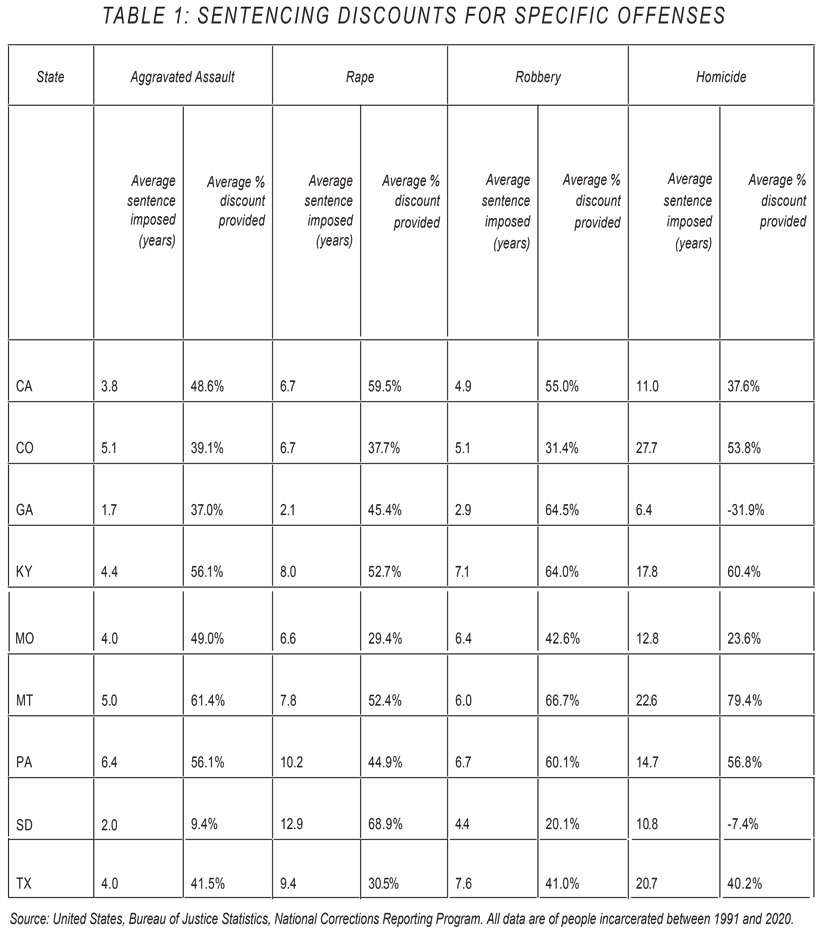
In almost a third of U.S. jurisdictions that make data available, the actual time served for rape is, on average, discounted by 40% from the sentence publicly imposed. This would mean a five-year minimum sentence applied in court ends up being three years of time served. For aggravated assault, robbery, and murder, nearly a quarter of the states with available data provide this kind of abatement.
Even these disturbing numbers significantly understate the enormous discounts the system routinely provides out of public view, because they represent the overall average percentage reduction, for both long and short sentences. The data show that short minimum sentences are likely to receive smaller discounts — the offender sentenced to one to three years is more likely to serve the one year or something close to it — while the longer sentences are heavily discounted. For example, in the case of aggravated assault, Wyoming provides an average 85% discount for sentences longer than six years and a -26% average discount for sentences less than three years. (Yes, there are sometimes negative discounts, as we explain below.) South Dakota averages an 88% discount for sentences longer than six years and a -9% one for sentences under three years. Similarly, for murder, Mississippi provides a 43% average diminution for sentences longer than six years versus only 20% for sentences under three years. South Carolina's average discount is about 47% for sentences above six years and an average discount of -17% for sentences less than three years.
Note that negative average percentage discounts commonly occur for short sentences. Where a jurisdiction sentences an offender to a range, such as one to three years or two to four years — the first number being the "minimum sentence" and the second number being the maximum sentence — a release at any time after the minimum sentence produces a negative percentage discount. Serving two years on a sentence of one to three produces a -100% discount off the minimum sentence, for instance. Serving three years on a sentence of two to four produces a -50% discount off the minimum sentence. These negative discounts, which are common for short sentences, end up dramatically reducing a given state's overall average percentage discount. Of course, this obscures the fact that its discounts for longer sentences are usually far higher. Likewise, even when the short-sentence discounts are not negative, long-sentence discounts still outstrip them, continuing to drag down the overall average.
Even in states where the overall average percentage discount is only 25%, the average percentage discount for midrange and longer sentences may reach 40%, 50%, 60%, or more. This means that every time a person hears of a sentence of six years or higher imposed by a court, without knowing the applicable statutes and practices of that particular state, he should probably assume that the sentence advertised will be reduced by 40% or more — perhaps much more. Exacerbating the problem is the fact that 98% of all criminal cases are resolved by plea bargain, meaning that most offenders have already received a significant discount off the offense they committed.
A number of states refuse to make public their data on sentences imposed or time served. Why, one might ask, do they withhold such significant information about their criminal-justice systems? The answer lies with how those states' systems are performing. In fact, two-thirds of the states failing to provide such data to the federal government's National Corrections Reporting Program represent a majority of the states with the worst re-incarceration rates within three years of release. (They almost all have rates of 36% or higher.)
To summarize, the vast majority of states have set up their sentencing systems in a way that allows them to announce in court a "minimum sentence" considerably higher than the time that will actually be served. Most states routinely use this legal authority to provide significant hidden discounts off the publicly announced minimum sentence, especially for midrange and longer sentences.
THE MECHANISMS OF SENTENCING DISCOUNTS
Sentencing discounts can come from four different sources. First, state statutes may authorize a parole commission to release an offender after serving a particular portion of the sentence imposed in court. For example, Colorado and Connecticut allow parole-commission release after serving 50% of the minimum sentence imposed for some crimes.
A second source of discounting is the fact that the vast majority of states give offenders multiple days of credit for each day in custody without a formal disciplinary infraction. For example, in California, Iowa, Alabama, Nevada, Texas, Arkansas, New Mexico, and Oklahoma, an offender receives two or more days in credit for each day actually served. Thus, an offender given a 10-year minimum sentence, who is eligible for release by the parole commission after serving only 50% — five years — can satisfy those five years by serving two and a half years. (A minority of states, including Oregon, limit the use of these credits for speeding up parole eligibility.)
Third, unless prohibited by law, an offender can get additional discounts by participating in programs in such areas as education, treatment, or rehabilitation. The additional discounts for such participation can be substantial: up to 30% in Nevada; 33% in Indiana and Rhode Island; 38% in Kentucky; 40% in Maryland; 50% in Missouri, Mississippi, and Colorado; and 68% in Texas.
A final source of huge sentencing discounts arises from special rules that cut through all other time-served requirements. For example, California law requires that, after serving 20 years, incarcerated persons must be released under the Elderly Parole Program upon reaching age 50, no matter what their "minimum sentence" originally was. This means a 30-year-old can receive a "life" sentence for multiple murders and rapes and, with few exceptions, can still be released after 20 years, at age 50. Because most offenders commit their offenses before age 30, the rule's practical effect is to set 20 years as the maximum sentence that one can serve in the state, regardless of the court sentence. Cody Klemp, for example, a serial rapist who attacked victims in broad daylight, was eligible under this program. When brought to court for multiple rapes of an underage family member, he was sentenced to 170 years. But after serving just 18% of his sentence, he was scheduled for release simply because of his age.
A victim in the Klemp case says: "We will become victimized, again, and again, and again because of it. I'm disgusted by the law." The state Board of Parole Hearings rescinded Klemp's early parole under district-attorney pressure, but he will be referred back to the same board at some point. Many other such special rules exist. For example, Oregon adds to its many other discounts a special and sometimes complete discount on non-violent-drug or property-crime sentences for some custodial parents, male or female, of a minor child.
One more special rule deserves mention. It is well known that many states have replaced the death penalty with a sentence of "life without parole." Many readers will not be surprised to learn that in some states this death-penalty substitute does not mean what it says. Massachusetts, for example, recently began permitting early release on parole even for some persons sentenced to "life without parole." Nor is Massachusetts the only such state. In Vermont, Gregory Fitzgerald spent months planning to kill his wife, and after trying to beat her to death with a baseball bat he reverted to strangling her to death. He was sentenced to "life in prison without the possibility of parole." Fitzgerald had long denied killing his wife, but in a deal with the state, he admitted to the murder and withdrew a civil lawsuit against the state in exchange for his release. He was indeed released on furlough, even though authorities found that this would be a "detriment" to the public and "potentially harmful" to the victim's family.
THE MOTIVATION TO DECEIVE
When politicians create a system in which long court sentences typically result in the offender serving far less time, this is not simply accidental trickery or inadvertent misdirection. Clear incentives drive this deception.
First, reducing long court sentences out of public view might appear to be an easy way to increase general deterrence without having to pay for it. Officials probably calculate that the threat of long prison terms will deter potential offenders, while in fact discounted sentences will reduce the heavy costs of incarceration. Prison, today's standard mechanism of general deterrence, can certainly be quite expensive. Perhaps the greater the disparity between the public deterrent threat and the actual time served, the more money saved in correctional costs. The problem comes when this veil of ignorance tears, and the deterrence target — and the general public — come to understand they have been routinely deceived.
A similar dynamic occurs in the context of political optics. Some liberal politicians may prefer much less punitive sentences but don't want to risk antagonizing the many community members who direct hostility toward "soft on crime" lawmakers. This consideration carries particular weight in periods of ongoing public concern about crime, like today. Appearing to be tough on crime while extending leniency in practice presents an attractive solution.
Some might expect sentencing deception to occur primarily in Democratic states: Liberal policymakers tend to worry more about mass incarceration, and would thus prefer to give lighter sentences. On the other hand, we might expect sentencing deception to be prevalent in red, Republican states because officials there would seek to reduce correctional costs while hiding the high discounts off public sentences for fear of their red constituencies' objections. Given these incentives, it should come as no surprise that sentencing deception happens frequently in both blue and red states.
Consider, for example, the practices in six of the largest states under dominant Democratic control — California, Colorado, Illinois, New Jersey, New York, and Washington — as compared to six large states under firm Republican control — Florida, Georgia, Missouri, Ohio, Tennessee, and Texas. The average percentage discount for aggravated assault is essentially the same across both groups of states. For red Missouri, it's 49%, and for blue California it's 48.6%; for red Texas it's 41.5%, and 39.2% in blue Washington. A similar red-blue parity holds for other serious offenses like robbery, murder, and rape. Comparing states does reveal a significant pattern: The states that give higher sentences in court tend to provide greater percentage discounts.
While red and blue states have similar sentence discounts, it does not follow that they have similar punishment practices. Blue states may sentence only the most serious cases to prison, while the red states sentence a greater range of offenders to prison. The point is that both sets of states engage in serious criminal sentencing deception through non-public discounts of publicly imposed sentences.
This deception takes its toll on politics. One widely accepted progressive claim is that U.S. criminal sentencing is viciously punitive, making America a "carceral state" that undertakes "mass incarceration." A closer look at the data, however, shows that the sentences imposed in court simply do not reflect time served. The sentences publicly announced might seem high, but the terms of imprisonment actually served are significantly lower. Those troubled by "mass incarceration" leap to blame "tough on crime" reforms such as mandatory minimum sentences and three-strikes statutes. Yet critics of these changes forget that they were enacted primarily as reactions to public outrage over discovered deception in sentencing. It is unsurprising that an angry public wanted to reform a system that released serious offenders early, regularly, and surreptitiously.
THE SOCIETAL COSTS OF DECEPTION
While the current system holds great appeal for politicians and anti-punishment activists, such people overlook the long-term societal costs of systematic deception. The practice of routine non-public early release does not in fact provide the deterrent threat its supporters tout. Sentencing deception will not fool the most important deterrent targets: active criminals familiar with the criminal-justice system. Instead, the practice primarily tricks the non-criminal public. Such institutionalized deception, once discovered or even suspected, undermines the criminal law's credibility with the community. All it takes is a few news stories about criminals reoffending during the term of their previously imposed sentence for citizens to grasp that something untoward is afoot out of public view. That realization invariably produces outrage and cynicism, tanking the system's credibility with the community.
Consider just three examples. Phillip Garrido kidnapped and raped a series of young women. In the late 1970s he was caught, convicted, and sentenced to 50 years in prison for the kidnapping of a victim, and five years to life for the rape of that victim. Despite the minimum sentences totaling 55 years, he was released on parole after serving only 20% of those 55 years. Within a few weeks of his release, he showed up at the workplace of his last victim. In a later interview she explained:
I had no idea he was out. I wasn't expecting him to be out....I got on the phone on my breaks and started calling. I called Lompoc Penitentiary. They said he had been released to...San Francisco City Jail pending parole. I called them. They said he was in an Oakland halfway house. I called them. They said here's his parole officer's number. So I made an appointment.
She says she has been living in fear ever since. A few years after that encounter, Garrido abducted an 11-year-old girl walking to her school bus stop, raped her, and held her captive for nearly two decades before being arrested again.
Terebea Williams was sentenced to 84 years to life after conviction for first-degree murder, use of a firearm, carjacking, and kidnapping in the killing of 23-year-old Kevin Ruska, Jr. The young man's body was found tied to a chair in a motel. Williams received more than a 75% discount off the sentence imposed in court. Dena Love, sister of the murder victim, struggled to comprehend how Williams was released so early:
It's absolutely devastating and mind-boggling that this has happened....[California authorities] should be ashamed of themselves for allowing this to happen, that the rights of the prisoners are more important than the rights of the victims and the victims' families. And it's absolutely shameful that this is being allowed to happen.
Kenneth Jackson was sentenced to 30 years for repeatedly lighting fires near Yosemite National Park. Now, having served just over a quarter of the sentence imposed in court, Jackson is set to be freed. The community he endangered is afraid. Janet Morita, a local resident, tells an interviewer: "I remember feeling almost paranoid, time after time, looking out the windows, looking for more smoke....It was a very traumatic time; he was setting fires almost every day." The county district attorney, Sally Moreno, added: "I'm angry. This is wrong and should not be happening."
For many politicians, the mirage of cheap deterrence and the useful political optics of sentencing deception appear to outweigh the fear of public displeasure in the case of discovery, and will do so up to the point that this blowback imperils their reelection chances. Unelected officials, meanwhile, might feel indifferent to public furor, maintaining that they know better than ordinary people how to do criminal sentencing. This kind of complacency fails to account for what we know about the power of normative influence in limiting crime. A criminal-justice system's loss of moral credibility with the community can prove highly criminogenic.
Damaged credibility decreases compliance, increases resistance and subversion, sparks vigilantism, and weakens the purchase of shared norms. Contrary to the assumptions of some advocates, people do not simply accept what the law says as fair and just without measuring it against their own intuitions of justice. A system that imposes liability and punishment that clash with a clear majority's sense of justice ends up undermining the criminal law's standing as a moral authority to be obeyed. When the criminal law corrupts its "brand," labeling something "criminal" means less and less.
Citizens are clearly not indifferent to the law's poor performance in doing justice. Think of the expressions of outrage and disgust about early release in the cases documented above. Do we think that such people, and others in those communities, will tend to trust and defer to the criminal-justice system as a reliable moral authority? History shows that when disillusionment with the criminal law sets in, lawbreaking spreads. People largely comply with the law because they view it as a reliable indicator of what society genuinely condemns. If the law appears unrepresentative of society's view of justice, its social influence suffers.
Releasing offenders long before completing the "minimum sentences" announced in court — and obscuring this fact — is the sort of action most likely to weaken the criminal-justice system's ability to gain compliance. Numerous controlled studies and natural experiments reveal this disillusionment-noncompliance dynamic at work. Sentencing deception, then, carries hidden costs that go far beyond the criminogenic effects of lost deterrence.
TRUTH IN SENTENCING
State policymakers who understand the perils of deception have precedents they can consult. In the 1970s, concerns about the effect of deceptive sentencing and early-release policies led federal authorities to seek the abolition of early discharge and the introduction of more truthful sentences. This "truth-in-sentencing" movement aimed to align publicly imposed sentences with the actual time offenders would spend in jail. Reformers found that the public had come to view the early-release system as unfair, disparate, and ineffective for controlling crime, leading to "diminished faith in any rehabilitative programming...." Studies vindicated this indignation, showing that many early-released offenders recidivated, often within the time frame of their original sentences.
The truth-in-sentencing movement culminated in the passage of the federal Sentencing Reform Act of 1984 (SRA), which abolished federal parole and required that public sentences match time actually served. The SRA also created the United States Sentencing Commission to craft guidelines that would assure consistency in sentencing and rationally explain the sentences imposed. During the SRA debates, some expressed concern that fully fixed sentences would hamper prison administrators' ability to control prison behavior, so the SRA allowed prison authorities to shave up to 15% off the original sentence for prisoners who maintained good behavior.
Support for the SRA grew once it became clear that the discretionary, non-public system for the early release of prisoners created unjustified disparity between similar cases and contributed to a reputation for obfuscation. The congressional report on the SRA concluded that examinations of current practice "clearly indicate that sentencing in the Federal courts is characterized by unwarranted disparity and by uncertainty about the length of time offenders will serve in prison." Legislators predicted that increased certainty from the SRA's more definitive sentencing would boost public respect for the law. The sentences announced would now represent the "sentence actually served" rather than one revised out of public view by the federal parole commission.
Judges would also appreciate the certainty and clarity of the new system because they would no longer need to adjust sentences in anticipation of what the parole commission might or might not do with them. Likewise, prison officials would now be able to plan work programs and realistic rehabilitative goals achievable within the time of the offender's actual sentence. Congress determined that the SRA met "the critical challenge of sentencing reform" and promised to "make criminal sentencing fairer and more certain."
MORE TRANSPARENCY, NOT INCARCERATION
Following the enactment and success of the SRA, many states adopted similar truth-in-sentencing laws, but nearly half did not. A 1998 report indicated that most of these states failed to do so because they believed it would require prison construction or administrative costs that would be "too high," even if the federal government provided grant money. Such concerns failed to see that greater transparency does not require more incarceration. States could have simply directed judges to impose public sentences matching their current time-served policies, which would produce no change in prison populations at all. Opposing such a change, then, appears to be driven primarily by the desire to avoid transparency with the public about current time-served practices. If politicians believe in the justice of those time-served practices, they should defend them to their constituents instead of masking them.
We do not necessarily urge longer prison sentences but rather more truthful sentences. Indeed, one of us has expressly argued for less use of prison and more use of non-incarcerating sanctions that punish serious offenses just as effectively. The argument here is simply for greater transparency. Thoughtful criminal-justice reform requires an accurate understanding of how the system actually works. Unfortunately, routine deception has distorted public perceptions of the current system. People have realized that the "minimum sentence" imposed publicly in court is rarely that.
More transparency will require reforms including, first and foremost, a shift to "truth in sentencing," where the public sentence will actually be served. Short of this, the public imposition of the sentence at least ought to disclose when, where, by whom, and under what criteria the actual time-served decision will occur. The judge should also make clear what the real "minimum sentence" is. Further, true transparency would entail all jurisdictions making data about their criminal-sanctioning practices publicly available. It is only with access to this full picture that reformers can intelligently debate the system's performance and propose improvements. Sentencing transparency is the only path to a criminal-justice system that does justice, avoids injustice, and earns back credibility with the community.