Closed Classrooms




One of the central justifications for universities is that they are needed to form citizens. Citizens need not just a fluency with the ideas that are contending for dominance in our democracy, but also an ability to assess them critically. This is especially true for the next generation of elites who will go on to exercise an outsized influence over national and international affairs.
This crucial role for academia raises some fundamental questions: How well are colleges and universities preparing the young to assume such powers? How well are they introducing students to the moral and political controversies that roil modern democratic life? Are students being exposed to a broad range of intellectual perspectives that give shape to these controversies and illuminate the complexity of the issues at stake?
To shine a light on these questions, we draw on a unique database of college syllabi collected by the "Open Syllabus" (OS) database. The OS database has amassed millions of syllabi from around the world primarily by scraping them from university websites. They date as far back as the late 1990s, though a majority are from the last 10 years. Most of the data come from universities in the United States, United Kingdom, Canada, and Australia. And while the OS doesn't make the raw data accessible, it offers a searchable website with useful analytic tools.
Together with our colleague Yuval Avnur, we used the OS database to explore how three contentious issues are being taught at universities: racial bias in the American criminal-justice system, the Israeli-Palestinian conflict, and the ethics of abortion. These issues have been important sources of division in our democracy. While the first two inspired massive protests from leafy campuses in southern California to the streets of Berlin, the latter issue has been the most enduring moral debate in the American culture wars.
In each case, we explored the extent to which the scholarly debates around each issue are taught to students. Therefore, we are not interested in whether disreputable demagogues and conspiracists are assigned to students. Rather, we are interested in whether students are exposed to a broad spectrum of the most reputable and informed thinkers, which includes professors and, in some cases, well-regarded intellectuals and writers outside of academia.
Guided primarily by citation counts and our own familiarity with the academic literature, we first identified some of the most influential texts on each issue. More than others, these works shaped the conversation around these issues, attracting praise as well as sharp criticism. As we'll see, for example, no work has had more influence on the study of race and the criminal-justice system than Michelle Alexander's The New Jim Crow. Similarly, Orientalism by the literary critic Edward Said, though it is not narrowly about Israel, has had a singular influence on how Jewish Israelis — and their conflicts with Palestinian neighbors — have been understood. And, finally, we examined Judith Jarvis Thomson's essay "A Defense of Abortion," which has had a uniquely powerful influence on debates about the ethics of abortion.
We then assessed the extent to which these canonical works are assigned with their most important intellectual critics. Are they taught in conversation with critical texts? Or are they taught with other works that tend to reinforce rather than complicate their main arguments?
Additionally, we flipped these analyses to see how often the most important critics of these canonical texts are taught with like-minded thinkers. Here again, we asked whether they are discussed along with the canonical texts they are criticizing, or are the critics simply taught with like-minded thinkers?
The OS database allows us to ask these questions, because its users can not only see how often texts are assigned, but also how frequently they are paired with other publications. It doesn't, however, allow users to do this latter analysis by country — so, we could not confine our analysis of frequently co-assigned texts to schools in the United States. However, as we'll see, most of the texts we study are primarily assigned in America.
To varying degrees, we found a strong asymmetry: While Alexander's, Said's, and Thomson's works are routinely taught, their critics are not. And when we flip the analysis to see how often the critics are paired with the dominant texts, we find that they generally are discussed together. In other words, in the comparatively rare cases when these critics are assigned, they are apparently taught to widen the conversation, not to cement a different orthodoxy. That suggests a minority of professors do teach these intellectual debates.
On the whole, though, it appears that professors generally insulate their students from the wider intellectual disagreements that shape these important controversies. That is the academic norm, at least in the cases we studied. This is a problem we must collectively remedy.
RACISM AND CRIMINAL JUSTICE
Few issues have vexed American politics more than the question of whether — and to what extent — the criminal-justice system is biased against black Americans. More than any other book, Michelle Alexander's The New Jim Crow: Mass Incarceration in the Age of Colorblindness, inspired a moral and political reckoning over race and our criminal-justice system. Published in 2010, the book featured on the New York Times bestseller list for nearly five years. Ibram Kendi said it was "the spark that would eventually light the fire of Black Lives Matter."
The academic influence of Alexander's book was no less significant. As of this writing, it has been cited nearly 19,000 times. The New Jim Crow also became popular in university courses, as it should have given its scholarly and political influence. In the OS database, it has been assigned 5,389 times, the vast majority (about 77%) in courses taught at American universities and colleges. Overall, that makes Alexander's book the 232nd-most assigned text, more popular than John Milton's Paradise Lost and William Shakespeare's Hamlet.
Alexander's book claims that American history should be understood as a cyclical struggle between white supremacists and advocates for racial justice. While advocates for racial justice eventually succeeded in overthrowing systems of racial oppression (as they did in the case of slavery and Jim Crow), white supremacists have been resilient. Thus, after the successful passage of the Civil Rights Act and Voting Rights Act, Alexander says, white segregationists waged a new drug war that stirred up racialized fears of urban crime and social breakdown. In this way, Jim Crow — a system of racial oppression and social control — was reborn, just in a more sinister form. The new system might have appeared fair and race neutral on the surface, but in fact, it was designed to subjugate black Americans.
Alexander's provocative thesis was challenged almost immediately by other scholars. Yale Law professor James Forman, Jr., began honing a powerful rebuttal in the pages of the New York University Law Review in 2012 (first released as a Yale Law School working paper in 2011). A critic of the war on drugs, Forman nevertheless thought Alexander's most significant empirical claims were wrong. Alexander's thesis, Forman wrote,
presents an incomplete account of mass incarceration's historical origins, fails to consider black attitudes toward crime and punishment, ignores violent crimes while focusing almost exclusively on drug crimes, obscures class distinctions within the African American community, and overlooks the effects of mass incarceration on other racial groups.
Finally, Forman added, "the Jim Crow analogy diminishes our collective memory of the Old Jim Crow's particular harms."
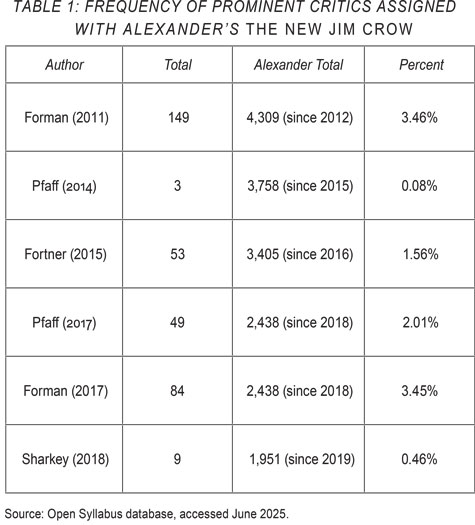
Forman's critique attracted great scholarly admiration. He himself, along with others inspired by his analysis, wrote subsequent books developing and refining it. But since 2012 his article has only been taught in about 3.5% of the courses that assign Alexander's book (see Table 1 below).
Powerful scholarly challenges to The New Jim Crow mounted in the years following Forman's article. These, as Table 1 shows, were ignored as well. One is the work of John Pfaff, a law professor at Fordham University. In 2014, he authored "Escaping from the Standard Story: Why the Conventional Wisdom on Prison Growth Is Wrong, and Where We Can Go from Here" in the Federal Sentencing Reporter. Pfaff showed that prison growth was not primarily caused by the war on drugs, as Alexander contended. Pfaff's article, though, has been almost entirely ignored by those who teach The New Jim Crow. It has been assigned with Alexander's book in only three courses in the OS database. Perhaps this oversight is understandable, though, since Pfaff's article attracted less scholarly attention than Forman's did.
The same cannot be said, though, of Michael Fortner's seminal book, Black Silent Majority, published by Harvard University Press in 2015. While Fortner shared Alexander's condemnation of the modern drug war, he disputed her account of its origins. Our draconian drug laws, Fortner found, grew out of the concerns of black working- and middle-class New Yorkers, who were seeking to protect their values and interests in the face of rising crime in the 1970s. Unlike Alexander, then, Fortner didn't find a racist conspiracy at the heart of the drug war. Instead, he argued that its origins were more complex and tragic. And he rejected Alexander's sense that blacks were merely the subjects, never the agents, of modern American history.
Fortner's book attracted widespread acclaim. It won the 2016 Herbert H. Lehman Prize for Distinguished Scholarship in New York History, awarded by the New York Academy of History. The New York Times Book Review selected Black Silent Majority as an "Editors' Choice" in 2015, while it received a Pulitzer Prize nomination as well. Even so, since 2016 Black Silent Majority was assigned only 53 times with Alexander's book. That means that it was taught with The New Jim Crow in less than 2% of the courses in the database.
In 2017, both Forman and Pfaff published books that developed the claims they made in their earlier essays. Pfaff authored Locked In: The True Causes of Mass Incarceration and How to Achieve Real Reform, a careful analysis on the causes of prison growth. Locked In was widely reviewed and attracted praise from across the ideological spectrum. Forman's book, Locking Up Our Own, confirmed much of what Fortner had written in Black Silent Majority. He argued that black mayors and police chiefs first rose to power at the moment crime was surging in American cities. Faced with that pressing challenge, they embraced tough-on-crime policies. Forman's book was a sensational success, winning the Pulitzer and being listed by the New York Times as one of the 10 best books of the year.
Yet neither book is assigned to college students very often with Alexander's groundbreaking work. Locked In and Locking Up Our Own have been taught 49 and 84 times, respectively, with The New Jim Crow since their release — a book that has been assigned in 2,438 courses since 2018. Clearly, the norm is to shield students from the wider academic debate, even if that isn't generally the conscious motive.
In 2018, Princeton sociologist Patrick Sharkey published Uneasy Peace: The Great Crime Decline, the Renewal of City Life, and the Next War on Violence. Unlike many prior criticisms of Alexander's book, Sharkey argued that some of the consequences of America's anti-crime crusades were positive, particularly for black Americans. Sharkey observed, for example, that violence reduction had been most stark in black neighborhoods. This change, Sharkey found, even improved educational outcomes for black children. Sharkey stressed that while the great crime decline improved the lives of the most vulnerable, it was also purchased at a significant social cost.
Sharkey's book was well received and attracted scholarly attention. But like Alexander's other critics, Uneasy Peace didn't find its way into classrooms very often. It has been paired with Alexander's book in only nine courses.
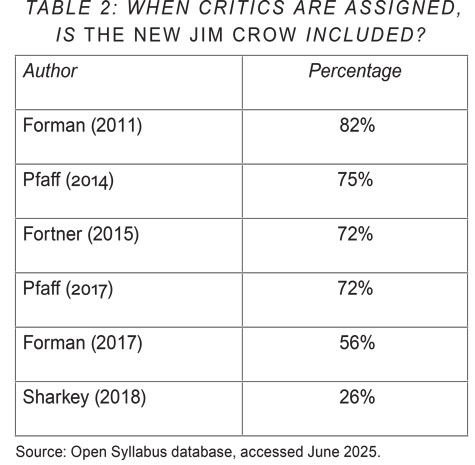
It's possible, of course, that other professors teach Alexander's critics by themselves, and thus stack the deck against her thesis. Yet in every case, The New Jim Crow is the most commonly assigned text with its prominent critics (see Table 2 below). In other words, when professors decide to actually teach these critics, they generally include Alexander.
It's true that Alexander is not always taught with these critics. But even when that happens, they are paired with other books that take a more critical view of the criminal-justice system. Consider Sharkey's book Uneasy Peace, a work that is paired with Alexander's only 26% of the time. Yet Sharkey is frequently assigned with more left-leaning voices, such as Forrest Stuart's Down, Out, and Under Arrest and Victor Rios's Punished. The general picture that emerges, then, is one in which a small minority of professors teach the scholarly debate over race and the criminal-justice system.
What is generally taught with Alexander's The New Jim Crow, if not her most important critics? It is voices who say that the West generally is far more irredeemably evil than Alexander contends. The top three titles assigned with Alexander are Angela Davis's Are Prisons Obsolete?, Ta-Nehisi Coates's Between the World and Me, and Michel Foucault's Discipline and Punish. Others in the top 10 include Paulo Freire's Pedagogy of the Oppressed and Ruth Wilson Gilmore's Golden Gulag. Broadly speaking, then, it appears that most of the authors assigned with Alexander are those that reinforce rather than complicate her critical perspective.
Why don't professors generally teach the scholarly controversy around Michelle Alexander's important book? A very partial answer might be that too many professors teach the book despite not having any real expertise in the scholarship on crime and punishment. This conclusion is suggested by the fact that Alexander's book is not infrequently assigned in fields outside of history, sociology, political science, and law. Roughly 27% of the time her book is taught by professors with expertise in English, theology, social work, education, and philosophy. This conclusion is reinforced by the fact that Alexander's critics are least likely to be assigned by professors in these fields. There are no syllabi, for example, where an English professor assigned Fortner's Black Silent Majority or Pfaff's Locked In.
Even so, most professors who teach The New Jim Crow are from fields we would expect: sociology, history, political science, and law. They may do better on average than their colleagues who teach English and education. But the norm, even for them, seems to be to protect their students from learning about the broader scholarly controversy that Alexander's book sparked.
ISRAEL AND PALESTINE
No intellectual has been a more influential critic of Israel than Edward Said. His 1978 book, Orientalism, popularized a framework through which today's advocates on behalf of Palestinians understand their struggle against the state of Israel and the West generally. Said cast the Western powers as the villains of history and peoples of the East as their noble victims. In his account, Westerners dominate the East partly by denigrating it to make it seem worthy of subjugation through a worldview he called "Orientalism." "The essence of Orientalism," Said concluded, is the "ineradicable distinction between Western superiority and Oriental inferiority." It falsely affirms an "absolute and systematic difference between the West (which is rational, developed, humane, superior) and the Orient (which is aberrant, undeveloped, inferior)."
Arabs are particularly stigmatized by Western Orientalists, according to Said: "For no other ethnic or religious group is it true that virtually anything can be written or said about it, without challenge or demurral." "Lurking behind" these dehumanizing prejudices, Said concluded, is "the menace of jihad," the "fear that the Muslims (or Arabs) will take over the world."
In Said's account, then, it was impossible to take Zionism seriously as one among the many nationalist movements that emerged in the 19th century, much less to see Israel itself as a land of refugees or the ancestral homeland of Jews. And, indeed, Said's Orientalism singled out Israel for special rebuke, suggesting that the state could be justified only if one accepted the xenophobic ideology at the core of Western civilization. Orientalism, thus, sought to turn the tables on the prevailing American understanding of Israel: It is not, in fact, an outpost of liberal democracy in the Middle East or a refuge from anti-Semitism, but an instrument of white supremacy.
Said wrote Orientalism not simply out of some abstract intellectual interest, but rather as "an Arab Palestinian in the West...." And even before the publication of Orientalism, Said's academic work was interwoven with his activism against Israel. Soon after publishing his dissertation on Joseph Conrad, Said joined the Arab-American University Graduates, a group founded in 1967 to "challenge Zionist constructions of the conflict in the Middle East." In 1970, he met Yasser Arafat and began a long-term collaboration with him and the Palestine Liberation Organization (PLO). Said translated Arafat's famous 1974 address to the United Nations General Assembly in which the PLO leader — with a holster bulging visibly under his jacket — claimed to be holding both a gun and an olive branch. For these contributions, Said was elected to the Palestine National Council in 1977 (where he sat until his leukemia diagnosis in 1991).
But Said's greatest contribution to the Palestinian cause was most likely his role as a public intellectual and progressive celebrity, to which the runaway success of Orientalism elevated him. It's hard to overstate the book's academic influence. As of this writing, it has been cited nearly 90,000 times. Orientalism is also the 16th-most assigned text in the OS database, appearing in nearly 16,000 courses. The handful of works that are more commonly assigned include textbooks and writing guides, like The Elements of Style by William Strunk and E. B. White.
The book is more popular abroad than Alexander's. In the U.K. alone, for example, Orientalism appears in an astonishing 7,673 courses in the OS database. But it is also big in the United States. When we confine our search to American colleges and universities, Orientalism appears in 3,825 courses in the OS database, just a bit less than Alexander's The New Jim Crow. And when we consider his work collectively, Said's scholarship appears in more American syllabi than Alexander's.
But if Orientalism enjoyed great academic success, it was also challenged by prominent critics who perceived deep and consequential cultural differences between the West and the Arab world. Of the scholarship in this tradition, perhaps none was more influential than The Clash of Civilizations by the Harvard political scientist Samuel Huntington.
Published in 1996, Huntington agreed with Said that the Arab world is sometimes caricatured by Westerners. Nonetheless, Huntington thought that cultural differences would increasingly drive world conflict — and that Islam, in particular, represented a threat to Western values and the world order. Huntington put the clash starkly: "The underlying problem for the West is not Islamic fundamentalism. It is Islam, a different civilization whose people are convinced of the superiority of their culture and are obsessed with the inferiority of their power." As for Islam, Huntington said the problem is a West that is convinced of the "universality of their culture" and their obligation to extend it abroad. "These are the basic ingredients," Huntington concluded, "that fuel conflict between Islam and the West."
More controversially, Huntington further claimed that Islamic countries were particularly prone to violence, arguing that the evidence for this claim was "overwhelming." "Wherever one looks along the perimeter of Islam," Huntington observed, "Muslims have problems living peaceably with their neighbors." "Islam's borders are bloody," he concluded.
Like Said's Orientalism, Huntington's book was polarizing. To some it seemed especially prescient, particularly after the terrorist attacks on September 11, 2001. To others, it appeared to be the work of an Islamophobe, cloaked in a thin scholarly veneer. Said, in particular, argued that Huntington's book was among the worst exemplars of Orientalist thinking. In "The Clash of Ignorance," penned for The Nation, Said called Huntington's book a "belligerent" work that "recklessly" pits Islam against the West.
If another book rivaled Huntington's challenge to Said, it was Ian Buruma and Avishai Margalit's Occidentalism: The West in the Eyes of Its Enemies, which turned the thesis of Orientalism on its head. First published in 2004, Occidentalism argued that it is the West that is portrayed in grotesque ways, and not just by its Islamist enemies in the East, but also by intellectuals in the West. Indeed, Buruma and Margalit contended that Occidentalism first originated in Western criticisms of the Enlightenment, and that such critiques have been adopted by various anti-modernists ever since, including by everyone from communists in the West to Islamists in the East. Occidentalism, they assert, is a "dehumanizing picture" of Western modernity, one that says it is essentially "soulless, decadent, money-grubbing, rootless, [and] faithless...."
Because Occidentalism was published just after Edward Said's death, he didn't have an opportunity to challenge it. Still, a review of Occidentalism in the New York Times noted that "it is easy to imagine what the relentlessly ideological Mr. Said would have seen in their work: yet another supposed instance of Western scholarship whose picture of the hostile, backward Oriental 'Other' invites the exercise of Western power."
Within the world of Middle East scholarship more narrowly, though, Said's most prominent intellectual foe was undeniably Bernard Lewis, then the most distinguished scholar of the Islamic world and a chaired professor of Near Eastern Studies at Princeton University. Lewis exemplified precisely the kind of scholar Said believed couldn't possibly understand the East; he was a white Westerner who grew up in colonial England. In Orientalism, Said gave Lewis special attention, denouncing him for essentially being an anti-Muslim propagandist. In 1982, Lewis hit back, penning "The Question of Orientalism" in the pages of the New York Review of Books. Lewis's disparaging review charged Said with ignoring the actual scholarship on the Middle East, including the work of Arab authors. In his later work, notably in Islam and the West (1993), Lewis accused Said of creating and living in an "alternative universe" disconnected from reality.
Their feud culminated in a much larger rift among scholars of the Middle East. Troubled by what he regarded as the politicization of the entire field by Said and his fellow critical theorists, Lewis teamed up with the Lebanese American scholar Fouad Ajami to found the Association for the Study of the Middle East and Africa (ASMEA) in 2007. Intended as a rival to the Middle East Studies Association (MESA), the new academic organization aimed to nurture an intellectual community beyond Said's framework.
Apparently, though, students won't learn much about the intense controversy that has attended Said's Orientalism — because his book is very rarely assigned with any of its critics. Instead, it is taught with titles that reinforce and extend its message. The authors include luminaries of critical theory, including Benedict Anderson, Michel Foucault, Frantz Fanon, and Judith Butler.
While all of these thinkers are certainly worth reading, they don't introduce much intellectual friction when assigned together. Their shared central goal is to delegitimize Western ideas that the authors fear justify oppression, with many perceiving the destruction of colonialism and its vestiges as the great moral battle of our era. It is thus no surprise that they draw on and seek inspiration in one another's work to mount an interlocking and comprehensive attack on Western intellectual and political traditions.
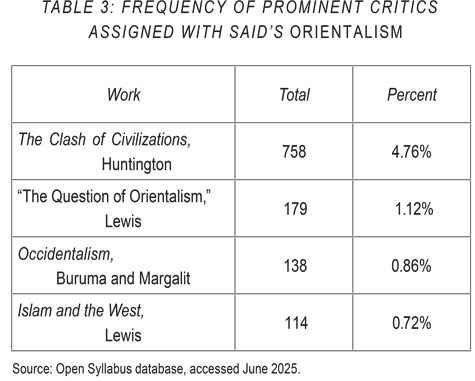
If we expand our review from these titles to the top 100 works assigned with Orientalism, it doesn't reveal many critics. One is the aforementioned Clash of Civilizations. It is assigned in 758 courses along with Said's book, a bit less than 5% of the time (see Table 3 below).
Huntington is an outlier, though. Buruma and Margalit's Occidentalism appears with Orientalism in just 138 courses, less than 1% of the time. Bernard Lewis is also almost never assigned with Said, despite their years of sparring. Lewis's "The Question of Orientalism" is assigned in 179 courses with Orientalism, approximately 1% of the time. Meanwhile, Lewis's Islam and the West is assigned with Orientalism even more rarely.
When we reverse the analysis and begin with Said's critics, however, we find that Orientalism frequently accompanies them. For example, in courses that assign Lewis's "The Question of Orientalism," Said's classic is taught 73% of the time. Orientalism is paired with Islam and the West about half the time. And, in courses that teach Lewis's book, Said's Culture and Imperialism is the second-most assigned title, discussed about 28% of the time. So, here again, we see the same pattern: While Lewis is almost never assigned with Said, Said is usually assigned with Lewis. Meanwhile, a significant minority (29%) of professors who assign Occidentalism also pair it with Orientalism.
Orientalism is taught in a wide range of disciplines in the humanities and social sciences. It is popular in history and political science. But it is also taught in more than 3,000 literature courses and hundreds of classes in the fine arts, media studies, and film. Overall, about a third of courses that assign Orientalism are outside of the social sciences and history. Presumably, scholars in these fields consider Said's work of relevance because they believe Orientalism infects Western literature and art.
In these humanities courses, though, that skeptical lens appears to go unchallenged. The syllabus database shows that the major works that challenge Said's theory are only occasionally taught in English or the humanities. Occidentalism, for example, is rarely taught in literature courses. Students in humanities courses are thus especially not exposed to the deep intellectual controversy that surrounds Said's social theory.
Some critics might argue that because Said's Orientalism isn't narrowly about Israel, it shouldn't be the focus of our analysis. For most students, though, Said's classic is their only serious introduction to the issue. Additionally, the story we tell here doesn't change if we focus on books that discuss the Israeli-Palestinian conflict more directly. When we analyzed the most commonly assigned texts that focus more narrowly on the history of that conflict, we found the same patterns. The strongest scholarly critics of Israel, such as Rashid Khalidi, James Gelvin, and Charles Smith, are both the most assigned texts and generally paired with fellow travelers.
THE ETHICS OF ABORTION
On the ethics of abortion, there has been no more influential work than Judith Jarvis Thomson's "A Defense of Abortion," published in the inaugural issue of Philosophy and Public Affairs in 1971. It has been cited more than 3,600 times and reprinted in numerous anthologies. It's also the most widely assigned text on the ethics of abortion, showing up in some 2,526 courses in the OS database. Most of these courses — roughly 71% — were taught at colleges and universities in the United States, not surprisingly given the issue's distinct salience in American politics.
Published prior to Roe v. Wade, Thomson rested her classic essay on liberal principles. Whatever the moral status of the fetus, Thomson argued, it does not have a right to be supported by the mother. She arrived at this conclusion by way of a now familiar analogy to generations of college students. Imagine, she said, that you wake up to discover that you have been attached to a famous violinist, who is suffering from a kidney disease. To be cured, he needs the support of your kidneys for nine months. Would it be unjust to detach yourself, Thomson wondered? She concluded that it would not be, writing that except perhaps in some cases, "nobody is morally required to make large sacrifices, of health, of all other interests and concerns, of all other duties and commitments, for nine years, or even for nine months, in order to keep another person alive."
Thomson's essay sparked a decades-long debate. It invited criticism by pro-life thinkers and commentary from pro-choice ones, many of whom defended the core of Thomson's claims against opponents of abortion. Some of the sharpest criticism came from Catholic philosophers, including Patrick Lee, Christopher Kaczor, and Francis Beckwith, among others.
What gets assigned with Thomson's essay? To the credit of many professors, the most commonly assigned text is "Why Abortion Is Immoral" by Don Marquis, a pro-life philosopher. As noted in Table 4 below, Marquis appeared with Thomson in more than a third of the syllabi in which her essay was taught. Though not a direct critique of Thomson, Marquis did at least present a case against abortion rights. After Marquis, the most commonly assigned texts included one by the pro-choice philosopher Mary Anne Warren as well as broader works in bioethics and philosophy.
Beyond Marquis's essay, two other works with pro-life sympathies appeared in the top 100 titles assigned with Thomson's essay. One is by Rosalind Hursthouse, "Virtue Theory and Abortion," which argued that abortion can be a morally troubling choice, regardless of the validity of competing rights claims. It is assigned about 7% of the time with Thomson. The other is a second essay against abortion by Marquis, assigned less than 5% of the time. Overall, then, it appears that a substantial minority of professors pair Thomson's famous essay with a pro-life perspective.
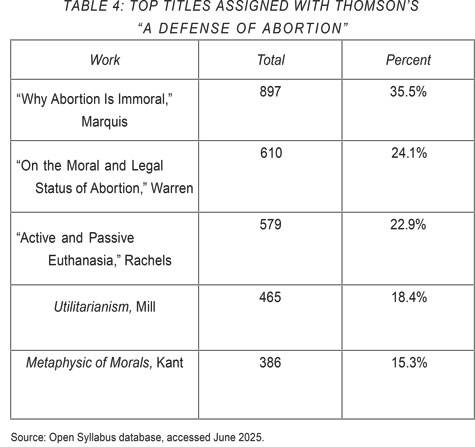
Courses that introduce students to the ethics of abortion seem better crafted than those that expose students to either racial bias in the criminal-justice system or the Israeli-Palestinian conflict. First, works that give arguments for the pro-life position are not uncommon — they are assigned with Thomson more than a third of the time. Second, Thomson is also often assigned with texts that provide students with intellectual tools to critically assess her philosophical assumptions. For example, John Stuart Mill's Utilitarianism, which is assigned 18.4% of the time with "A Defense of Abortion," challenges Thomson's strong emphasis on the primacy of autonomy.
Additionally, commonly co-assigned texts provide alternatives to each other. For example, Immanuel Kant's approach is a stark alternative to Mill's utilitarianism, suggesting that many of these classes are designed around disagreements rather than presenting a consensus on issues. One can reasonably hope, then, that the spirit in which these varied texts are taught is one of debate and critical engagement. Even so, there is no substitute for assigning pro-life arguments in their most cogent and powerful form along with Thomson's classic case for abortion rights.
Why are professors better at teaching scholarly disagreement in the case of abortion than with regard to the criminal-justice system or Israel? It doesn't seem to be because those who teach issues related to gender, generally speaking, do a better job of exposing students to intellectual disagreement. Judith Butler's Gender Trouble, for example, ranks among the most assigned texts in the OS database, taught in more than 10,000 courses. Yet it is almost never assigned with works that challenge her core arguments, such as her notion that all observable differences between the sexes are due to social construction. Instead, she tends to be taught with other thinkers who share her anthropology, particularly Michel Foucault, Edward Said, and Simone de Beauvoir.
What, then, is a better explanation for the inclusion of a broader range of scholarly voices in courses that teach the ethics of abortion? A likely answer is that the narrow topic of abortion ethics is nearly always offered by philosophy departments, which is a discipline whose pedagogical aims explicitly include exposing students to competing arguments and answers to questions, prodding them to form their own reasoned views. That said, even in this case, most professors seem to teach Thomson's famous article on behalf of abortion rights without pairing it with any scholars who argue on behalf of a right to life.
Perhaps, though, some professors teach pro-life voices without considering pro-choice ones. Given the possibility, we explored the most commonly assigned texts with "Why Abortion Is Immoral" by Don Marquis. When Marquis is assigned, we find that it is taught along with Thomson roughly 75% of the time. Additionally, the second-most assigned work with Marquis's article is a pro-choice piece by Mary Anne Warren. We should also note that Michael Tooley's book Abortion and Infanticide — an important work of pro-choice scholarship — is assigned with Marquis 13.5% of the time. Thus, it seems that Marquis's essay is almost never taught by itself, without any pro-choice texts.
That doesn't mean that pro-life works of scholarship are never taught by themselves. After reviewing the most prominent pro-life scholarship, we managed to find one such work: Defending Life by Francis Beckwith, a philosopher at Baylor University. This book has been taught in 48 courses in the OS database. Unlike Marquis's article, though, it is assigned exclusively with other works that align with its moral perspective, particularly Christian ones. And it is taught almost entirely in a small number of Christian colleges and universities.
The fact that some professors at evangelical colleges are offering a sectarian education isn't particularly surprising, though. What is troubling is that so many professors at secular institutions, many of which are public, are behaving as if they teach in a seminary.
Furthermore, the works that develop a pro-life case in the most sustained, sophisticated way are almost never assigned. One is Patrick Lee's Abortion and Unborn Human Life, now in its second edition. Lee is well regarded in the field and a chaired professor at Franciscan University. Yet, his book is assigned in just two courses in the OS database. Christopher Kaczor's Ethics of Abortion — now in its third edition — does better, with appearances in 29 syllabi. Like Lee, Kaczor is no marginal figure in these debates. David Boonin, a prominent pro-choice thinker, admires Kaczor's book, claiming it is "one of the very best book-length defenses of the claim that abortion is morally impermissible."
TEACHING CONTESTED QUESTIONS
Skeptical readers might advance a number of reasonable arguments against our case. They might say, for example, that our findings shouldn't be trusted because the OS database doesn't include a random sample of syllabi. But there is not much reason to suppose that the syllabi that are publicly available are the ones that are also the least balanced.
Others could object that maybe this problem isn't really an American one. After all, we couldn't perform an isolated analysis of syllabi that are offered in just American universities and colleges. This objection is weaker in our first and last cases, though, given that texts such as Alexander's The New Jim Crow and Thomson's "A Defense of Abortion" are generally assigned in U.S. universities. But it is undeniably stronger in the case of the Israeli-Palestinian conflict. Roughly 75% of the appearances of Orientalism in the OS database are from colleges and universities outside the United States.
While it's possible that texts like Orientalism are taught differently in America, there are also reasons to doubt that proposition. First, the academic world isn't siloed, especially at universities across Anglophone nations. Academic institutions recruit from international talent pools, and many professors who teach abroad received their Ph.D.s at American universities. Second, pro-Zionist voices are so rare in the database that even if they were assigned only in the United States, we would still find a curriculum that often blinds students to the scholarly controversy about Israel and Palestine.
Others still might say that our findings tell us nothing about how these texts are taught. It's possible, after all, that these professors teach contentious texts in a spirit of openness and critical engagement. This might be true, but even if this is the case, it is not a substitute for hearing from critics themselves. Would those who make this objection, for example, find it acceptable if we found the same asymmetry, but in reverse? Would they find it acceptable if Michelle Alexander or Edward Said were both rarely assigned or taught alongside critics who showed up in thousands of syllabi?
And, finally, some might object that not all courses need to include a broad range of perspectives. There is nothing wrong, after all, with teaching courses on critical theory, American conservatism, or radical political thought. But it's one thing to acknowledge that such courses have a place in the university, and another to say that students don't need to be exposed to the intellectual controversy around the issues that shape our public life. Perhaps that could be achieved if universities offered a wider mix of "one-sided" courses — that is, by increasing inter-class diversity rather than intra-class diversity. No matter how we do it, students need exposure to a broader range of ideas.
Why is it important to teach these controversies in full? While there are many compelling reasons to do so, we would emphasize those that touch on our duty to form good citizens.
First, students need to acquire some fluency in the intellectual controversies that shape our nation and world. If all we expose them to are disagreements within cramped intellectual spaces, then we are not preparing them to think seriously about contentious public issues, much less exercise power over them one day.
Second, wrestling with and discussing controversies in full will help students to acquire the civic skills they need to become citizens in a pluralistic nation. Classrooms are rightly understood as schools of democracy, places where young people practice democratic disagreement. That activity should also cultivate students' intellectual virtues, such as curiosity, critical-thinking skills, and intellectual humility.
Third, insofar as we're educating tomorrow's leaders, they probably won't lead us anywhere we want to go if they have a distorted sense of social reality. In other words, the pursuit of justice requires good truth seekers — and that, in turn, necessitates a broad exposure to the most informed minds. As John Stuart Mill argued in On Liberty, this is how we fallible human beings collectively inch toward a better approximation of the truth. The most radical voices don't have a monopoly on wisdom. Like the rest of us, they are prone to error.
Of course, some professors might object to the arguments presented here on any number of grounds. They might, for example, say that in their judgment, particular perspectives see further than others, and it is their obligation to teach their students what is most illuminating. So, let's assume for a moment that this is true. Even if the likes of Alexander, Said, and Thomson are infallible, it would still be wise to teach their critics — if only, as Mill reminds us, to offer a fuller understanding of the truth. As Mill famously stressed in On Liberty:
He who knows only his own side of the case, knows little of that. His reasons may be good, and no one may have been able to refute them. But if he is equally unable to refute the reasons on the opposite side; if he does not so much as know what they are, he has no ground for preferring either opinion.
In other words, if we fail to teach the critics of Alexander or Said or Thomson, students may embrace their perspectives out of prejudice, not real understanding.
Additionally, even if Alexander, Said, and Thomson speak the full truth, many citizens in our nation don't think so. We, the people, are deeply divided about issues such as the treatment of race in our institutions, abortion, and the Israeli-Palestinian conflict. This means that understanding our fellow citizens — and gaining more respect for them by seeing their perspectives in their most cogent forms — requires an engagement with intellectual voices who depart from the received academic wisdom of our day.
Other professors might offer a different objection: We shouldn't distract students with wider scholarly controversies because, if we are to make good citizens, the young must marinate in the depth of the world's many injustices. Only those cold dives will awake them from their complacent torpor and motivate them to do something to make the world a better place. Whereas, if professors do as we suggest, students will walk away from their classes with the sense that the world is messy and complicated, making them less inclined to devote their lives to changing it.
Oddly, though, this counterargument suggests that the best education is a bad one. It presumes that students shouldn't be exposed to broad intellectual disagreements, lest they lose conviction. In this respect it is similar to some religious institutions, whose aim is not liberal education, but rather indoctrination. But if we are in the indoctrination business, we can hardly take the high ground when we protest the accusations coming from the Trump administration. And, if we fail to teach a broad spectrum of intellectual views on the issues that most divide us, we shouldn't be surprised when certain factions of our demos decide they don't want to support us anymore.
Professors may resist these kinds of suggestions by appealing to academic freedom. We agree that they should be largely free to teach without outside interference. But professors also have responsibilities to their students. For example, they have a duty to not teach topics that reach well beyond their expertise. And unless they are teaching at explicitly sectarian institutions, they should aim, as much as possible, to discuss academic controversies rather than scrub them from the curriculum. These responsibilities stem from an implicit contract between teachers and students in universities devoted to liberal education. Students should expect that their professors are not systematically screening them from intellectual disagreements or presenting contested points of view as if they were orthodoxies.
In the long run, the best way to restore public trust in academia, subvert the anti-intellectual currents on the right, and prepare our students for citizenship is to embrace liberal education at its best. Above all, universities must recommit themselves to teaching our disagreements. Notice that this is not a narrow call for assigning conservative intellectuals, cloaked in a broader appeal for more viewpoint diversity. On some issues such as abortion, we certainly do need to teach more scholars who are conservative, as we Americans tend to understand the term. But on other issues such as Israel and the criminal-justice system, we simply need to hear from those academics — including many from the left and center — who significantly depart from voices like Said's and Alexander's. In other words, how much the spectrum of voices should include genuinely conservative ones depends on the issue. Conservatives are simply more active in some scholarly debates than in others — and, naturally, course syllabi should reflect that fact.
How might curricular change happen? We suggest that every university that cares about liberal education needs to have a better sense of how it's actually teaching contentious issues such as the ones we've profiled here. To that end, universities could simply do an internal assessment of their curriculum. Some may discover that they perform better than this essay suggests.
Those universities that don't could convene a group of professors who are open to making more space for scholarly dissent in their courses. Universities could further encourage such undertakings by offering generous course-development grants to faculty who want to widen their students' intellectual horizons. These sorts of curricular evaluations could also become a regular feature of academic assessments. For example, such curricular assessments could become part of the external reviews of university departments as well as evaluations for tenure and promotion. On the basis of these reviews, university presidents and deans might reward departments with more hiring lines and resources when they show a commitment to teaching a broad range of scholarly perspectives.
Our findings might be interpreted as evidence for the excessive politicization of higher education. We are often told, after all, that universities have become "too political." In another sense, though, our evidence shows the opposite: Universities aren't politicized enough. Courses that evade or deny scholarly controversies sideline political contention — and it's this marginalization of politics that has undermined public confidence in the university. The irony is that we can only temper the current political war over higher education by building more contention into campus instruction. We don't see another path toward restoring public confidence in the university.